Addressing the darkness under the lighthouse
(灯台下暗し)
DENNOU AI
We chose "Dennou" (電脳) because it means "cyber brain" in Japanese. It reflects what we're after - tools that not only work alongside people, but elevate. Ada Lovelace saw computers as partners that could help us think and create in new ways, not just as fancy calculators. Our streamlined approach addresses the 灯台下暗し - shining light on the overlooked potential right beneath us. That's exactly what we're building.From Messy Data to Decisions That WorkWe help financial institutions, insurers, and businesses turn fragmented data into production-ready AI. Consulting today. Platform tomorrow.

WHAT WE DO
We Build the Foundations, Then the Intelligence
Most AI projects fail before they start. Not because the AI is wrong, but because the data underneath it is not ready. We fix that first.
Our work spans the full stack: cleaning and structuring data, building the pipelines and warehouses that make it usable, and then layering in AI that is genuinely fit for production. Whether that means a RAG system, an agentic workflow, a credit decisioning engine, or a collateral verification tool, we start where your data actually is, not where it should be.
We operate as a consulting practice today, with a platform product in active development. Clients get senior expertise from day one, and systems that are built to last beyond the engagement.
CAPABILITIES
Practical AI Across the Full Stack

Data Engineering and Data Products
Before AI can work, your data has to be clean, connected, and trustworthy. We design and build data warehouses, master data management systems, and single customer views that become the foundation for every AI application on top.
AI Credit Decisioning
Automated loan assessment with human-in-the-loop review. Built for lenders and microfinance institutions in markets with thin credit bureau coverage, where the speed and accuracy of each decision directly affects portfolio quality.
Physical Asset Verification
AI-powered collateral appraisal for vehicles, machinery, and equipment. Reduces manual inspection costs, flags misrepresentation, and produces a formal auditable record for every assessment.
Agentic and RAG Systems
We build agentic workflows and retrieval-augmented generation systems that let your teams query, analyse, and act on large volumes of documents and operational data. Accurate, auditable, and designed for real business environments.
Analytics and Performance Platforms
Dashboards and intelligence layers that give leadership and operations teams genuine visibility. Agent rankings, portfolio risk flags, loan performance trends, and customer behaviour patterns, all in one place.
WHO WE WORK WITH
Built for Institutions That Operate in the Real World
We work with microfinance institutions, credit-only lenders, asset-backed finance companies, insurers, and UK small and medium businesses that need serious AI capability without the overhead of a large technology procurement.
Some of our clients are digitising for the first time. Others have data infrastructure already in place and need AI layered in carefully. In both cases we start with an honest assessment of what is ready and what is not, and we build from there.
We work across East Africa, Southern Africa, and the United Kingdom.

THE DENNOU DIFFERENCE
We Start With Your Problem, Not a Product
No Vendor Lock-In: Your data, your logic, your environment. We configure AI around your risk appetite and business rules. We do not ask you to conform to ours. Everything we build is designed to be owned and operated by your team.Built on Real Experience: Our team has delivered AI systems for automotive manufacturers, finance institutions, and agricultural ventures across Europe, Australasia, and Africa. We have built production pipelines, not demos.Cutting Edge, Applied Practically: We recently received a grant of 20,000 hours of high-performance compute to develop and improve localised AI models for emerging market applications. What we build reflects the current state of the field, applied to problems that actually matter.Designed to Be Handed Over: We build for lean IT teams, intermittent connectivity, and live operations. Our engagements end with your team in control of what we built, not dependent on us to keep it running.
WHERE WE ARE NOW
In the Field, Not Just on the Whiteboard
We are currently live with clients across Africa and the United Kingdom, deploying AI systems in production environments rather than controlled pilots. That includes work in financial services, data infrastructure, and operational AI.
If you are evaluating AI for your lending operation, your insurance business, or your data infrastructure, this is a good time to talk.
Let's Talk About What AI Can Actually Do for Your Business
No hype, no jargon. A straight conversation about where AI fits and where it does not, for your specific situation.
© Dennou AI. All rights reserved.

Casino Royale: The House Always Wins
In the glittering new casino of AI, the house always wins. Are you sure you're not the one paying for the table?Businesses are rushing to place their bets on third-party AI platforms, chasing quick jackpots in productivity and efficiency.But very few are asking what happens "behind the curtain."- Who truly owns the intelligence created from your data?- What happens when the house learns your winning strategy?- Is your "promise" of data privacy just good marketing?Before you push more of your chips onto the table, you need to understand the rules of the game. I’ve detailed my thoughts below.

Your Most Valuable Player is a liability. It's time to use them to help build better armor.
What started out as a quick and dirty demo turned into a fully fledged production pipeline. By systematically working through and optimizing the system design and architecture, we're now performing demos to clients with a scaled-down version of a production-ready pipeline.The feedback for all this extra work? Transparency, trust, attention to detail has been the consistent client response. Them seeing us as passionate about their data as they are is simply infectious.We've taken the classic philosophy of samurai armor and re-engineered it for the 21st century. Instead of layering heavy steel, we've used enterprise-grade data engineering to build a flexible chassis, then interlaced it with the lightest, most advanced AI. The result isn't just armor; it's a bespoke tactical suit optimized for the speed and precision of John Wick. It's brutally effective, yet because it's 80% data pipeline, it's also modular and adaptable to your changing business needs.
Your Most Valuable Player is Your Biggest Liability. AI Can Fix That.
In engineering, we have a term for this: the "bus factor." It measures how many key people would need to be hit by a bus to derail a project. When that number is one, you don’t have an MVP; you have a single point of failure.We experienced this firsthand when we spent six months trying to reverse-engineer a critical process after an expert left. An AI we built did it in seconds. This highlighted a clear lesson: the solution to human knowledge gaps had to be technological.But which technology? The traditional business response is to throw people and money at the problem by hiring consultants. This is a temporary fix at best—a costly exercise that produces manual reports report, allowing you to make decision with stale data.The modern tech response is equally flawed: "just throw it at a big LLM." This too is a band-aid, failing for three critical reasons:
It Doesn't Scale
An LLM might handle one 500-page document. But what about 200 of them? The context windows break, and the API costs become astronomical. It’s simply not built for enterprise-scale knowledge.Your IP is at Risk
Are you comfortable uploading your core intellectual property... your "secret sauce" freely given to a third-party AI provider? For most businesses, the answer is a hard no.It's a Black Box.
Off-the-shelf AI solutions give you an answer, but no reasoning. There’s little-to-no source tracing. When it fails, you have no idea why, and you have almost zero options for customization. It either works or it doesn't, and that’s not good enough.
The Solution: Hierarchical Summary Generation
Lets step through the core architecture.
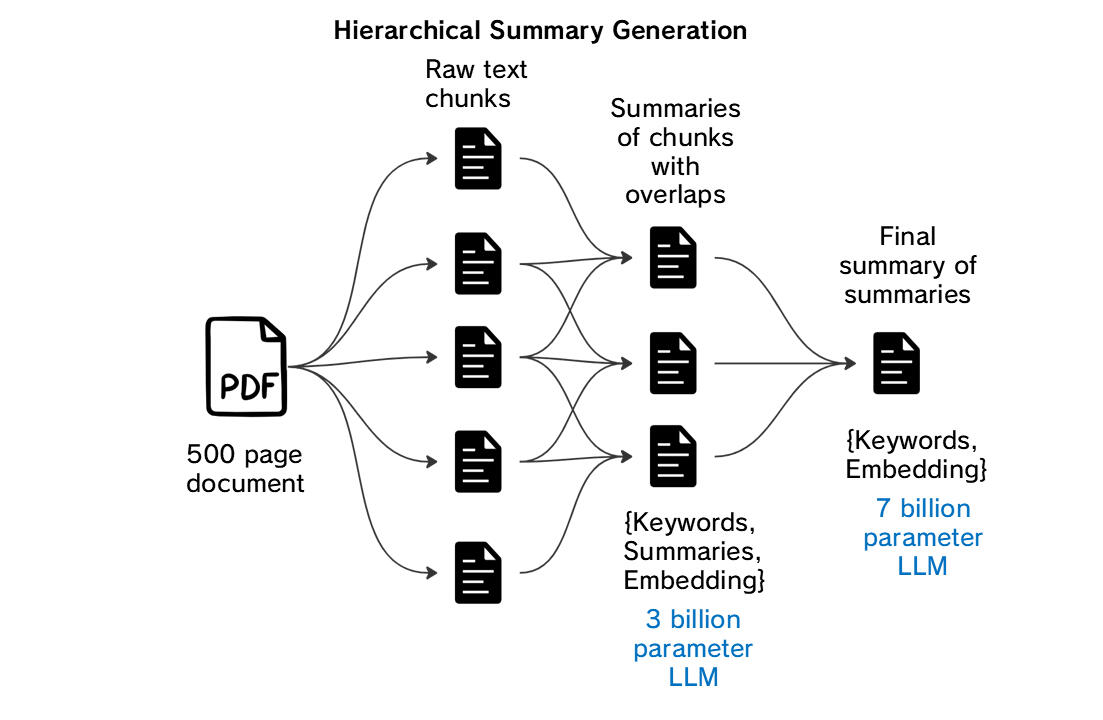
Systematic information distillation that preserves accuracy while enabling fast retrieval.
Layer 1: Chunk Processing
- Split documents into overlapping segments (25% of text chunks make it into other summaries)
- Individual LLM processing per chunk
- Extract keywords and entities from each
Why this matters: No detail gets lost to context window limits. Each piece gets full attention.Layer 2: Dynamic Batch Synthesis
- Group chunks into digestible batches (~20 summaries)
- Recursive layering—batch summaries get re-batched and re-summarized
- Vector embeddings done on summary population
- Continuous keyword aggregation across layers
Why this matters: Mimics human information processing. Progressive meaning-building vs. naive concatenation.Layer 3: Final Summary
- Single executive overview from condensed summaries
- Master keyword list from entire document
- Becomes your catalog metadata
Production Implementation
Storage pattern:
- Images/assets → Cloud storage with metadata links & schematics to text generation
- Chunk summaries → Document-specific BigQuery tables
- Final summaries + keywords → Central catalog table
Retrieval Strategy: Smart Matching Before Heavy Lifting
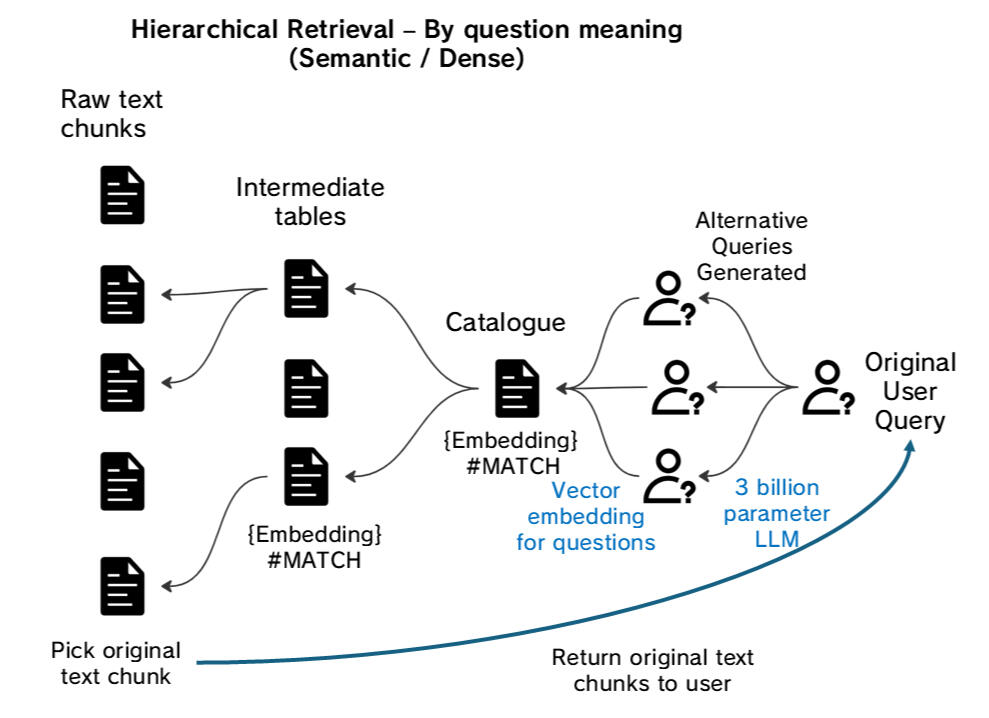
Firstly we apply query expansion first:
LLM generates alternative queries to cast a wider semantic net
(e.g., "tail lamp" → "stop light", "rear light", "brake light")Next we look at semantic matches; matching the meaning of the question by embedding the question into a vector and checking the embedding with the vector database.Instead of searching each in the database, we can narrow down the relevant topics quite easily.Three-tier approach:
- Catalog matching: Expanded queries hit final summary metadata first
- Intermediate retrieval: Pull relevant batch summaries if needed
- Deep context: Access raw chunks + associated files from storage
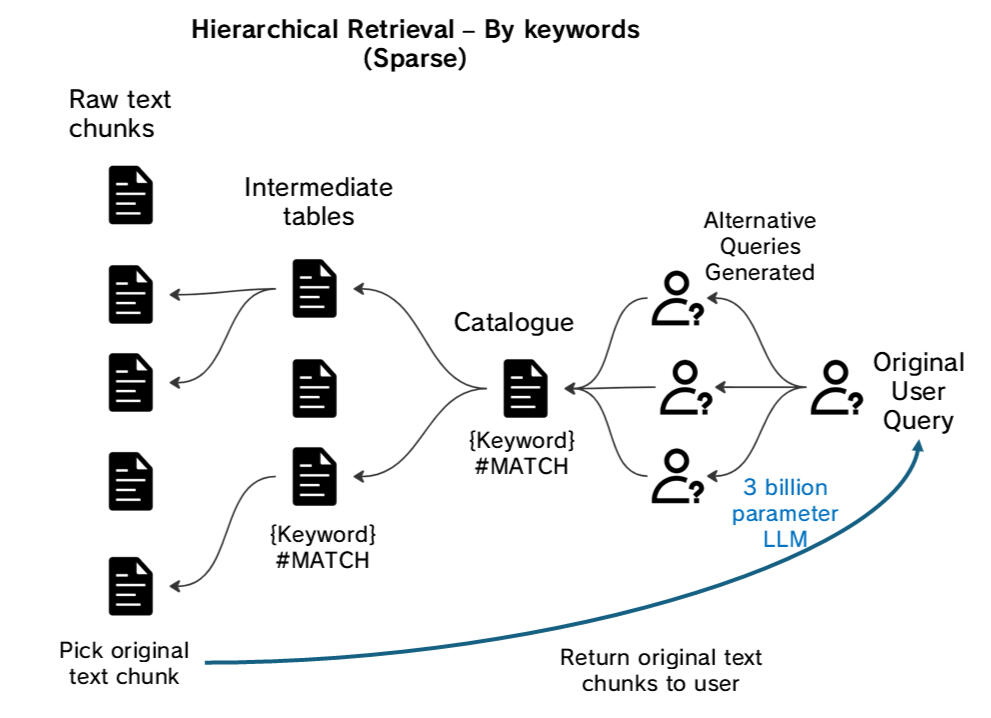
Repeating the process for keywords matches only.
Ensure another avenue for matches to happen (in the event that it can't find a close enough "meaning" match).The balance between dense & sparse has to be fined tuned for the use case.
Production Implementation
Query flow:
- Lexical matching against aggregated keywords
- Semantic matching against summary embeddings
- Targeted deep-dive into relevant document tables only
- Schematics returned if relevant or available
Why This Approach Wins
Accuracy: Systematic processing eliminates hallucination from context overload
Scalability: Handles any document size; architecture grows with data volume
Auditability: Natural checkpoints for human review and verification
Performance: Intelligent pre-filtering reduces compute costs
Bottom Line
What started out as a quick and dirty demo turned into a fully fledged production pipeline. By systematically working through and optimizing the system design and architecture, we're now performing demos to clients with a scaled-down version of a production-ready pipeline.The feedback for all this extra work? Transparency, trust, attention to detail has been the consistent client response. Them seeing us as passionate about their data as they are is simply infectious.We've taken the classic philosophy of samurai armor and re-engineered it for the 21st century. Instead of layering heavy steel, we've used enterprise-grade data engineering to build a flexible chassis, then interlaced it with the lightest, most advanced AI. The result isn't just armor; it's a bespoke tactical suit optimized for the speed and precision of John Wick. It's brutally effective, yet because it's 80% data pipeline, it's also modular and adaptable to your changing business needs.
© Dennou AI. All rights reserved.

Casino Royale: The House Always Wins
The current AI landscape can be understood as a grand, glittering new casino. The "house" consists of the large LLM platform providers like Google and Microsoft/OpenAI, along with the major applications built on top of them.The "game" they offer is intoxicating: unparalleled productivity, instant analysis, and access to superhuman capabilities. The "chips" that businesses must bring to the table are their most valuable assets: their proprietary data, their confidential client information, their unique business processes, and the hard-won expertise of their people.
The Allure of the Casino Floor: The Short-Term Wins
When a business, like a law firm shares its data with an AI provider, it figuratively steps onto the casino floor, the initial experience is fantastic. The "house" makes it easy to play. The user interface is sleek, the results are immediate, and the small jackpots are frequent.
A junior associate drafts a complex contract in 30 minutes instead of five hours. That's a jackpot.
A team instantly summarises 500 pages of due diligence documents. That's a jackpot.
The business feels smart, modern, and efficient. They are winning hands, and the cost seems low... a simple subscription fee, like buying chips at the cage. This is the pragmatic, short-term gain that my inner "critic" correctly identified as compelling.
How The House Guarantees Its Win: The Long-Term Loss
But like any casino, this one is built on a mathematical certainty: in the long run, the house always wins. It achieves this not through a single rigged game, but through the fundamental architecture of the casino itself.
The House Watches Every Card You Play. You are right, the "promise of no retention... is just a promise." Even if we accept the technical argument that the content of your documents isn't permanently stored to train their models, that's not the only way the house learns. It logs the metadata of your game: what questions you ask, what problems you solve, what features you use. It sees every "tell," every brilliant move your subject matter experts make. It is building a perfect, planetary-scale understanding of your strategy.
The House Uses Your Strategy to Create a New, Unbeatable Game. This is the "Great Commoditization." After observing thousands of players solve due diligence or tariff classification, the house identifies the winning patterns. It then builds a new, automated game—an AI agent—that perfectly replicates that expert strategy. It offers this new, cheaper, automated game to everyone, including your clients. The expertise you revealed at the table has been captured, productized, and used to make your own high-value service obsolete. The house used your own chips to fund the R&D for a game you can't possibly win.
When You Suspect a Cheat, the House Investigates Itself. This is the "Investigative Black Hole" we discussed. If you suspect your M&A strategy, which you analysed at their tables, has leaked to a competitor at the next table, who do you complain to? The house's security team. You are bound by the house's rules—the "contractual fortress"—which limits their liability and places the impossible burden of proof on you. You can never truly know what happens "behind the curtain."
Stop playing at the public casino where the odds are stacked against you.
At your table, you owns the cards, the chips, and the room. The data never leaves your control.
Every hand played makes your "house" smarter. The expertise of your best players is captured in your own proprietary AI, creating a compounding asset.
You control the security cameras. The audit trail is yours alone. There is no "behind the curtain."
Let us help you build your own private table
© Dennou AI. All rights reserved.